Prix de Rome
The Prix de Rome Architecture is the oldest, most prestigious award in the Netherlands for architects up to 40 years of age, commissioned by the Ministry of Education, Culture and Science, is organized every four years by Creative Industries Fund NL.
The international Prix de Rome jury has selected four entries for the shortlist of the Prix de Rome Architecture. The nominees are: Dérive (Hedwig van der Linden and Kevin Westerveld), Maarten Plomp and Iris van der Wal, Namelok (Wiegert Ambagts and Kaj van Boheemen) and Słodka x Zatta (Izabela Słodka and Federica Zatta).
The nominees receive a budget to work on a follow-up assignment over a period of four months. In this next phase, the designers will be asked to further develop their problem definition and positioning in relation to the theme Terminal Velocity. They will work towards a spatial intervention for a site of their own choosing, as a response to an ‘acceleration’ that is changing our world faster than we can adapt. Based on the outcomes of the working period, the jury will select a winner on 17 December 2026. The winner will receive a sum of € 60,000 and support for an international residency programme of their choice. The results will be on display from December at the Nieuwe Instituut in Rotterdam.
judging
The jury made its selection from 60 anonymous entries by architects, urban designers, interior architects, landscape architects and other spatial designers who responded to the Open Call: Terminal Velocity. Each of the shortlisted candidates presented a topical, relevant and strongly coherent spatial statement, which made the jury keen to see the further development of their proposals. In addition, the jury recommended four entries for an honourable mention, because they serve as examples for other designers seeking to establish their own position in relation to the major challenges facing the field of spatial design.
The full jury report can be found here.
The jury of the Prix de Rome Architecture 2026 consists of: Lesia Topolnyk (winner Prix de Rome 2022, architect, founder StudioSpaceStation), Dirk Sijmons (landscape architect, co-founder H+N+S Landscape Architects), Nick Axel (deputy editor e-flux Architecture, head of Architectural Design at the Gerrit Rietveld Academy), Paul Cournet (architect, founder CLOUD), Inez Tan (architect, partner Office Winhov), Ekim Tan (architect, founder Games for Cities, director Play the City) and Ivo de Jeu (programme manager architecture at the Creative Industries Fund NL, technical chair).
history
The history of the Prix de Rome dates back to 1666, when the award was established in France by King Louis XIV. Louis Bonaparte introduced the Prix de Rome to the Netherlands in 1808 to promote the arts in the Kingdom of Holland. Since 2005, one architecture edition and two visual arts editions have taken place during each four-year period.
Previous Prix de Rome editions
Lesia Topolnyk was the winner of the Prix de Rome Architecture 2022 with an entry inspired by the wreckage site of flight MH17. The jury of the Prix de Rome Architecture 2022, consisting of Afaina de Jong, Alessandra Covini, Carson Chan, Dirk Sijmons, Jan Jongert and Syb Groeneveld, selected Topolnyk over nominees Arna Mačkić, Dividual (Andrea Bit and Maciej Wieczorkowski) and Studio KIWI (Kim Kool and Willemijn van Manen) who all made new works for the prize. The architect has received the prize of € 40,000 and a residency of her choice from former State Secretary Gunay Uslu (Culture and Media) at Nieuwe Instituut in Rotterdam, where the exhibition opened.
Commissioned by the Ministry of Education, Culture and Science, the Prix de Rome Architecture in 2022 was organized by the Mondriaan Fund, in collaboration with the Creative Industries Fund NL and Nieuwe Instituut.
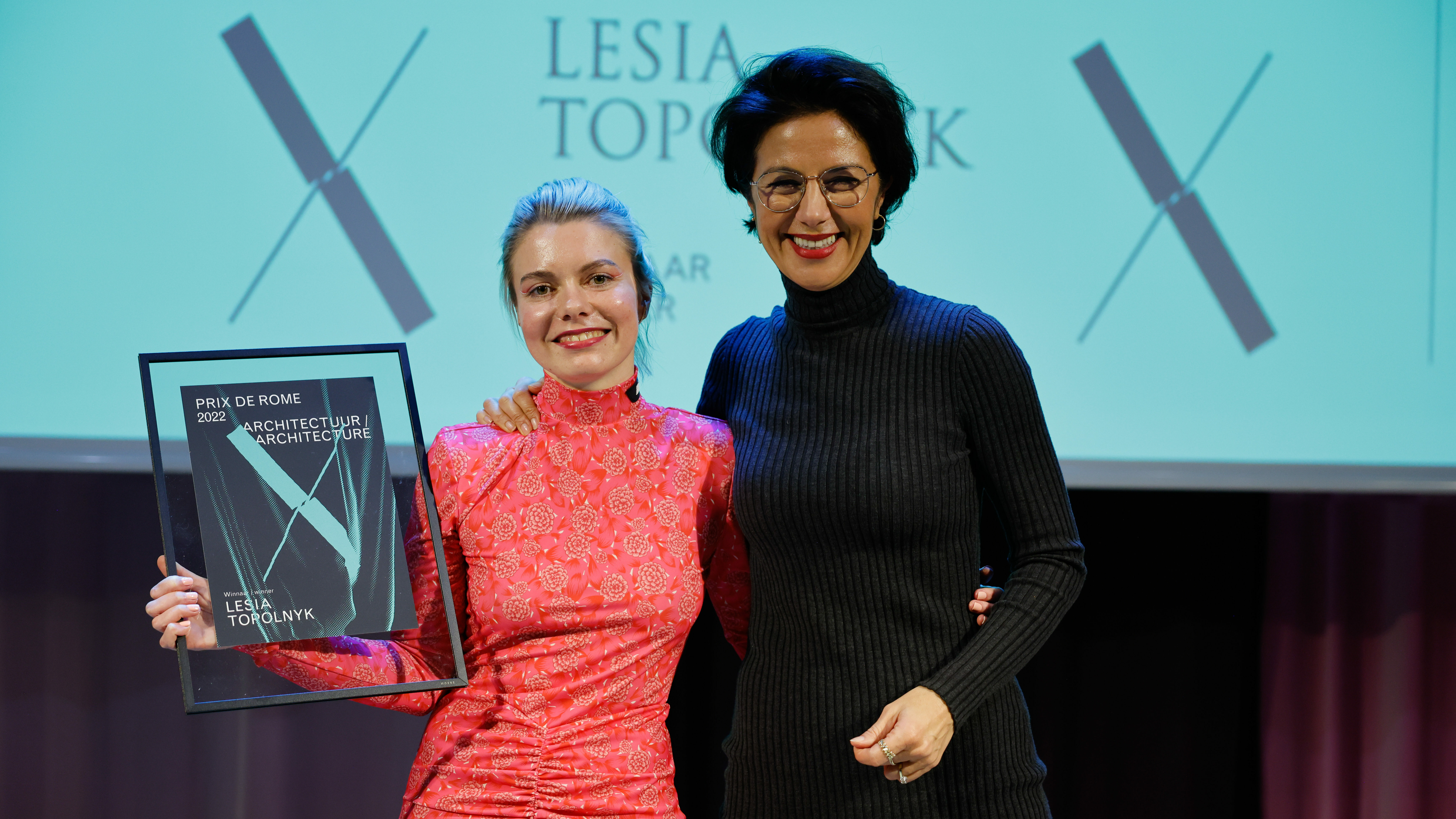
The theme of the Prix de Rome Architecture 2022 was Healing Sites. The prize invited architects, urban designers, landscape architects and other spatial designers to reconsider and redesign spatial practices. The jury called for proposals that challenged the status quo of our contemporary condition and that explored new methods, values and design expressions based on a self-selected site.
Below are the four short films about the nominees that were made in the run-up to the Prix de Rome Architecture 2022 exhibition at Nieuwe Instituut.
no innocent landscape - lesia topolnyk
In the Ukrainian mining village of Hrabove, which made world news when passenger flight MH17 was shot down there in 2014, Lesia Topolnyk demonstrated how spatial design can help make drastic events comprehensible and help heal their consequences. The landscape that forms the backdrop is itself never entirely innocent—there is No Innocent Landscape, she establishes. You can read the layered nature of landscapes with the aid of a 'magnifying glass' such as the moment when pro-Russian separatists shot down the aircraft, killing all 298 passengers. This reveals the complicated interplay of global and local histories, in this case from the attack itself to the illegal mining activities in the region. Architecture mediates in this process: using narrative and construction techniques, the design reveals what was previously concealed. According to Topolnyk, meaningful reconstruction can only take place on the basis of such deconstruction.
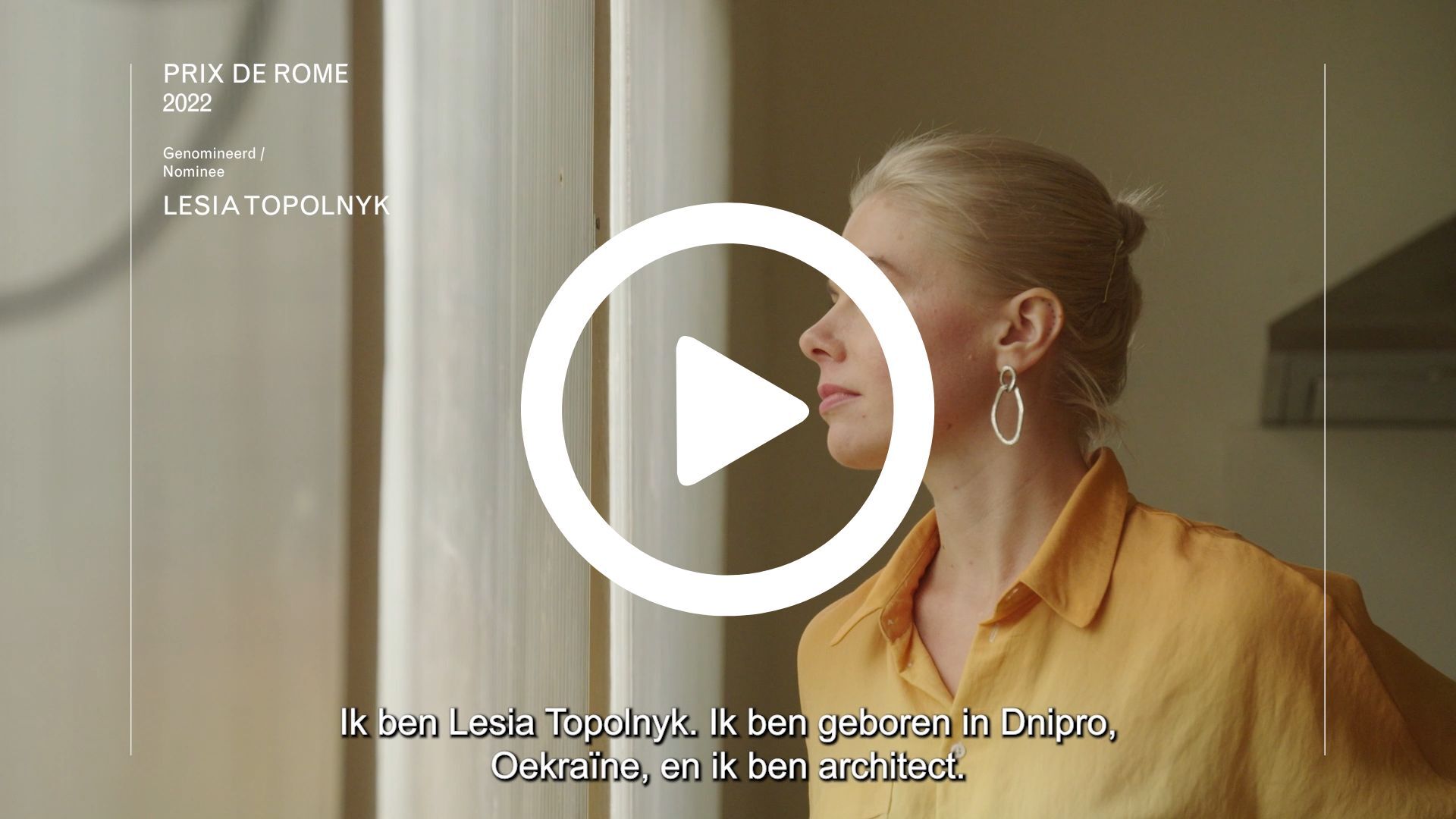
public centre for architectural disaster and collective healing - arna mačkić
In The Hague building where the Yugoslavia Tribunal tried human rights violations in former Yugoslavia until 2017, Arna Mačkić established a public centre for the collective healing of architectural disasters. Architecture is held accountable here for human and ecological relationships that have been destroyed or disrupted by architectural intervention. Mačkić's design confronts the original building that Ad van der Steur designed in 1953, but also reconciles with it. There are communal mediation spaces where victims of designed adversities can make themselves heard, and you'll find workspaces where architects can exchange ideas and insights with other disciplines. These alternative proposals for shaping the built environment offer new future perspectives to all those involved. Without condemning the entire profession or imposing certain truths on individual designers, the centre works on architecture as a constructive discipline capable of (critical) self-reflection.
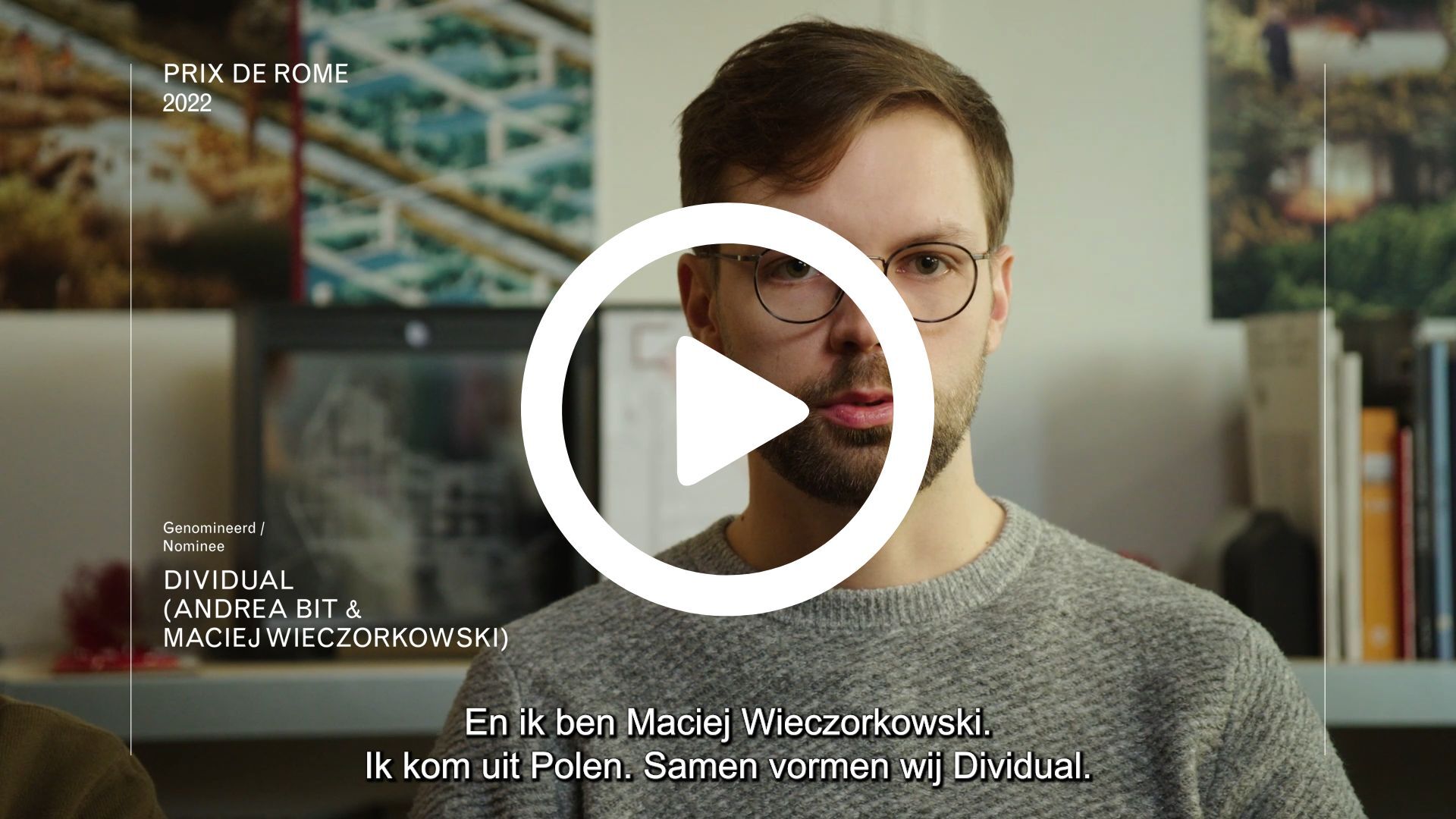
celebrating the unproductive - dividual
On the grounds in Veenhuizen, Drenthe, where the poor were 'cured' of their poverty through agricultural labour, Dividual created a strip in honour of the unproductive—the unprofitable or useless. Andrea Bit and Maciej Wieczorkowski celebrated uselessness at the site of a nineteenth-century social experiment. In contrast to the hard labour that the elite imposed on orphans, homeless people and beggars to improve their individual characters, Dividual proposed the communal meaning of work and an alternative interpretation of 'public benefit'. When you place landscape architecture in the service of the community, they say, it changes both the design and the designer. Space emerges for the cultural, material and natural resources that the collective needs. The diagonal strip that is excluded from all productivity gradually becomes wild in this design proposal, whilst the surrounding landscape transforms into a hyper-efficient system that generates water, food, electricity and water.
grounds of [in]justice - studio kiwi
In the offices where the Tax Authority wronged tens of thousands of Dutch citizens with reclaims that violated the fundamental principles of the rule of law, Studio KIWI seeks to establish new grounds of justice. The design studio transforms buildings where trust in the government reached a low point into sites where work can be done on rebuilding trust and compassion. At each of the locations, Kim Kool and Willemijn van Manen make a spatial intervention that corresponds to a step in the healing process. They create spaces for anger and atonement, but also for conversation, commemoration and the exchange of stories. The interventions are tailored to the locations themselves. What was already there and what is still needed to create an impactful environment? With Grounds of [in]Justice, they aim to heal what has been damaged and reduce the likelihood of it happening again.
![Grounds of [in]justice - Studio KIWI](https://cms.stimuleringsfonds.nl/storage/media/studio-kiwi_still_play-button.jpg)
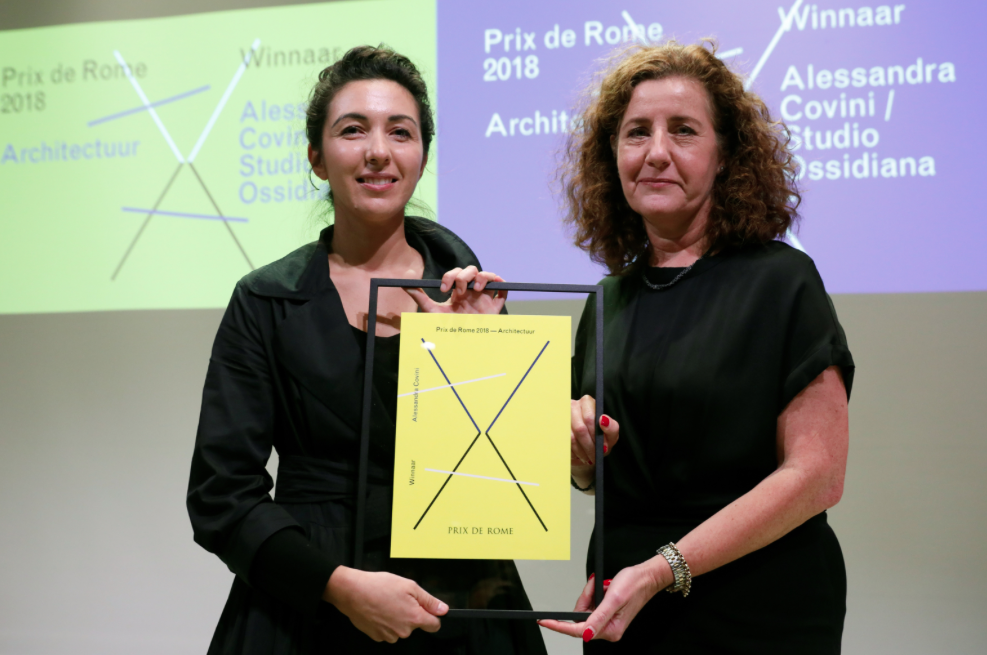
Architect Alessandra Covini won the Prix de Rome Architecture 2018 for her spatial proposal Amsterdam Allegories. The brief focused on the Low Pressure rural area in East Groningen. To this end, 66 architects, urban planners and landscape architects designed an intervention for the area around the villages of Hongerige Wolf and Ganzedijk and the dike in between. The jury, consisting of Mels Crouwel, Frank Havermans, Afaina de Jong, Oana Rades and Peter Cachola Schmal selected four architects for the shortlist: Alessandra Covini, Bram van Kaathoven, Katarzyna Nowak and the duo Rademacher de Vries. They created new work especially for the prize, which was on display at Nieuwe Instituut in Rotterdam.
Commissioned by the Ministry of Education, Culture and Science, the Prix de Rome Architecture in 2018 was organized by the Mondriaan Fund, in collaboration with the Creative Industries Fund NL and Het Nieuwe Instituut.
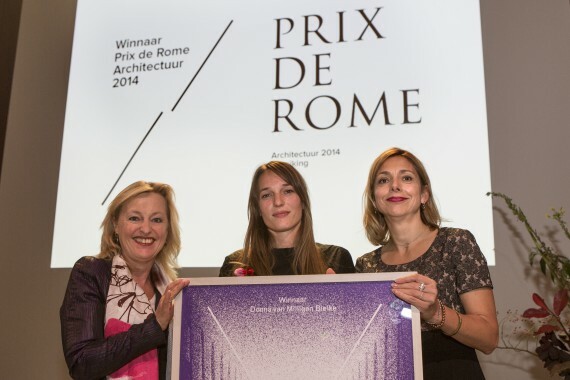
Architect Donna van Milligen Bielke won the Prix de Rome Architecture 2014 with the design Cabinet of Curiosities. The fictitious assignment formulated by the jury of the Prix de Rome Architecture 2014 focused on the Hoogstraat in Rotterdam. The shortlist was formed by the eight nominees Steven Delva, Anne Holtrop, Florian Idenburg, Marieke Kums, Kees Lokman, Donna van Milligen Bielke, Jasper Nijveldt, Tim Prins and the duo XML (Max Cohen de Lara and David Mulder).
Discover more