Architecture centre GRAS prompts Groningen to reflect on the living environment
Who decides what the city looks like? Officially, it is local councils, developers and designers. But GRAS (the Groningen architecture centre that has been fostering discussion about the built environment since 1999) is convinced that this question needs to be framed much more broadly. After all, the living environment concerns everyone: neighbours who want to make their street greener, business owners who see retail premises disappearing, and students looking for a place to live. With an annual programme packed with presentations, (live) podcasts, expeditions, workshops and its own online magazine, GRAS challenges the people of Groningen to contribute their ideas on the future of their own city, supported through the Activities Programme Grant Scheme. The scheme is open again from 13 May 15:00 CEST up to 15 June 16:00 CEST 2026.
29 April 2025
Shared responsibility
Groningen is facing major challenges. The city council is working on a new environmental vision, in which housing, the energy transition, climate adaptation, efforts to combat poverty and a healthy living environment take centre stage. These are issues that affect everyone, but which are rarely discussed on a broad scale.
This is precisely what GRAS wants to change. ‘The living environment concerns us all,’ says executive director Peter Michiel Schaap. ‘That is why we want to involve as wide an audience as possible in the discussion about its quality. Not as spectators, but as active participants.’
There are now several buildings in the city that would have been demolished without us.
GRAS has been doing this for years as an independent platform, by organising, putting issues on the agenda and encouraging action. In recent years, the organisation has developed a distinct voice of its own. ‘We take a stand and speak out,’ says Schaap. ‘That has definitely yielded results. There are now several buildings in the city that would have been demolished without us.’ A telling example is the old strawboard factory De Halm in Hoogkerk. GRAS wrote about the impending demolition and the fight to preserve this industrial heritage, and continued to actively engage in plans regarding the future of the complex. With success: together with the village of Hoogkerk and the council, project developer MWPO is now considering what new use this historic site could be put to.
Investing in building culture with We gaan naar Parijs!
The programme of activities for 2025 and 2026 is supported under the Activities Programme Grant Scheme and concerns what GRAS calls ‘investing in building culture’. Under the title We gaan naar Parijs! (We’re off to Paris!) – a deliberate nod to the climate targets – the organisation is focusing on cohesion between disciplines, parties and challenges.
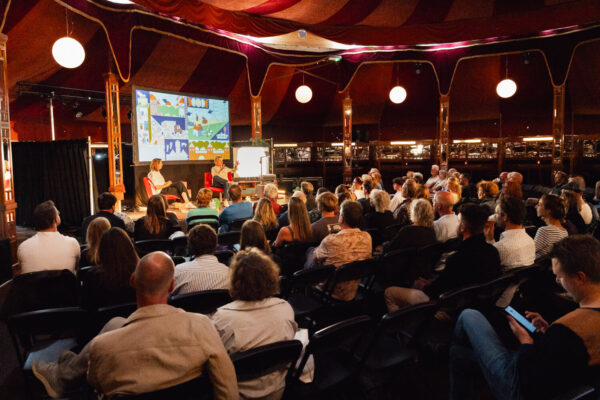
This takes various forms. For instance, HOOP is a series of discussions without a moderator, presented at the major Groningen summer festival Noorderzon. Here, GRAS puts two experts with different perspectives opposite each other, and they then explore new solutions for contemporary challenges through conversation. ‘It’s an antidote to the despondency that lurks in the background,’ says Schaap. ‘By bringing together people who didn’t know each other well, new insights emerge.’
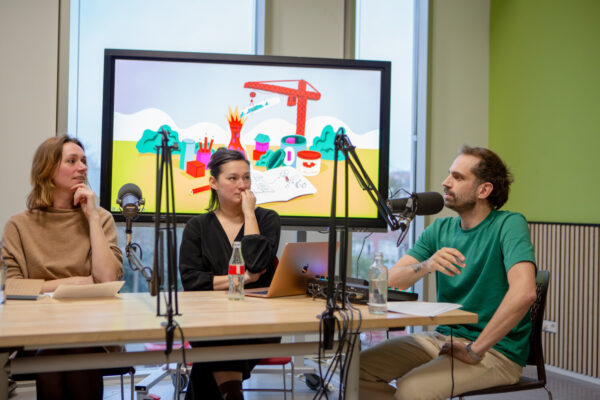
With the new live podcast Het College van..., GRAS challenges expert guests to come up with concrete proposals, free from political agendas, for Groningen’s major spatial issues. Current city-council questions and the agenda of the ‘real’ Municipal Executive form the basis. And at Nachtbrakers // Plannenmakers (a collaboration with the Academy of Architecture Groningen), mixed teams work in a single day on design solutions for specific cases put forward by public and semi-public commissioning clients.
This latter approach has already yielded results. Within this format, a mixed team of designers, policymakers and residents developed a vision for Groningen’s Diepenring (the historic ring of canals), which is being incorporated into the project plans. ‘It shows that with design thinking, you can really set something in motion,’ says Schaap. At the same time, he remains modest about direct causal links. ‘Urban development is slow. Good plans always have multiple parents. It’s the result that counts.’
Design thinking can really set something in motion.
Not news, but in-depth analysis
In addition to the programmes, the online magazine plays a central role in the activities of GRAS. The magazine is explicitly not a news medium, but a platform for background and in-depth analysis. It covers spatial themes, the interaction between people and places, and special projects in the city. Among other things, the magazine publishes so-called Plekportretten: stories that reveal the layers of a specific location in Groningen. How did a project come about? What was the vision for the design? How was new life breathed into a neglected area? A recent example is Dudok aan het Diep: an old petrol station in the city centre that was completely renovated, including a radical redesign of the public space.
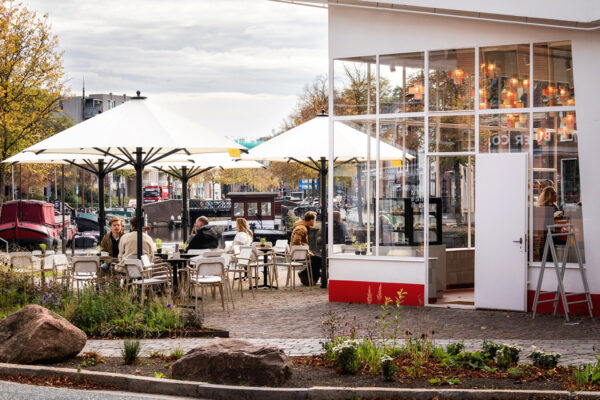
‘A good, compelling story like that of Dudok aan het Diep can foster a sense of connection,’ says Schaap. ‘That is precisely why we regularly highlight projects that are convincingly different and better. Not to celebrate the result, but to show how the process was organised: by parties that inspire and challenge one another.’
GRAS’s programme of activities was made possible in part by the Creative Industries Fund NL’s Activities Programme Grant Scheme. The Activities Programme Grant Scheme is open again from 13 May 2026 at 15:00 CEST until 15 June 2026 at 16:00 CEST.
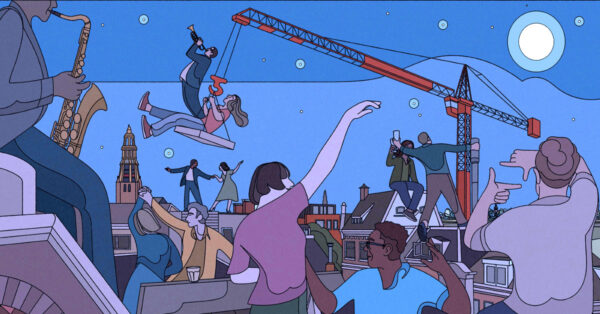
Header image: Illustration Nachtbrakers Plannenmakers 2026 by Megan de Vos