
Porrelen: het regenereren van de bollencultuur – KCCM
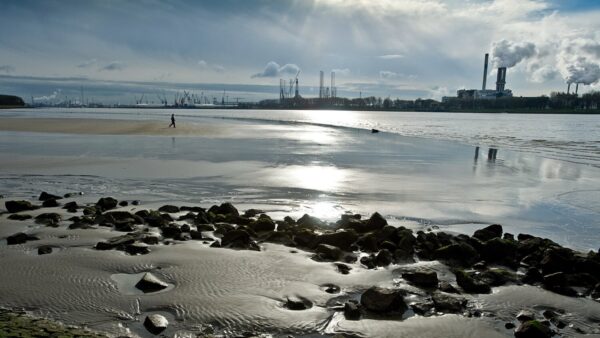
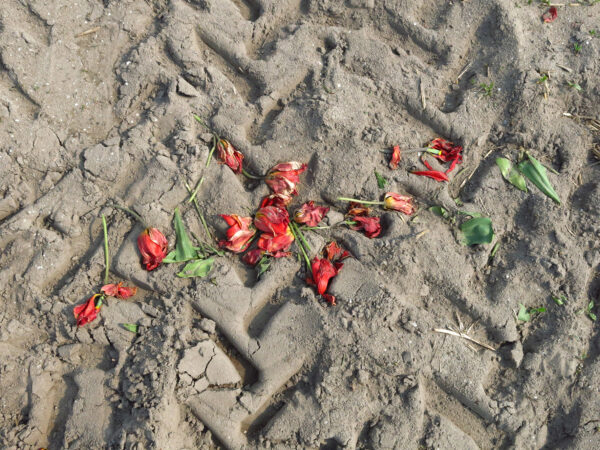
The Bollenstreek (Dutch bulb-growing region) is struggling with water shortages, salinisation, monoculture, and damage caused by pesticides. In Porrelen: het regenereren van de bollencultuur (regenerating the bulb-growing culture), KCCM and Copijn investigate how the region can transform from an exhausted monoculture into a regenerative landscape, based on polyculture and reciprocity. Here, the landscape is viewed as a living system and a partner. Through design-based research and local collaboration, new forms of land use and identity are worked out. The project is developing a timeline that visualises what the landscape was, what it is now, and what it could become. This timeline serves as a tool for discussion and reflection to explore alternative visions of the future. As well as KCCM and Copijn, NIOO-KNAW and Dendrologic are also part of the core team.
Open Call Regenerative Regions – 15 projects selected
During the development phase of the Open Call for Regenerative Regions, 15 projects were selected. For this call, the Creative Industries Fund NL invited (spatial) designers to collaborate with parties from other sectors to conduct design-based research into spatial strategies for regenerative regions.
15 April 2026
In 2050, the Netherlands aims to be climate neutral and have a circular economy embedded in a healthy and biodiverse living environment. To achieve that future, making our current systems more sustainable is not enough. It requires ways of living, working and coexisting that actively contribute to the well-being of communities and ecosystems. What is needed now to shape a regenerative living environment and society, and what spatial choices can we make today to develop (bio)regions that do justice to well-being, sustainability and regional distinctiveness?
general impression
The proposals taken into consideration demonstrate the breadth of the challenge being addressed. Designers look for answers in a variety of systems and contexts: ranging from the depleted flower fields of the Bollenstreek and the grain fields of Flevoland, to river clay in Gouda and the forests of the Veluwe. They link ecological restoration with food production, cultural heritage with the circular economy, and community building with spatial design.
The advisory committee was positive about proposals that effectively integrate knowledge sharing with research, for example through participatory elements. For instance, Mapdraft’s Concrete Harvests organises workshops with farmers and local stakeholders concerning the schokbetonschuren (prefabricated agricultural barns made from vibrated concrete) in the Noordoostpolder.
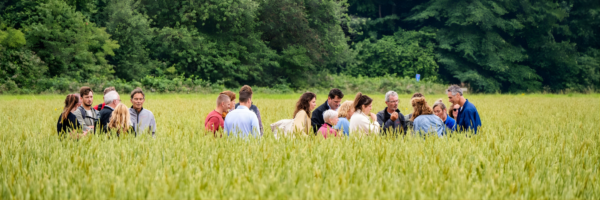
The committee also appreciated projects that examine the landscape across multiple levels of scale. Polder Parade by Stichting 'n Wilde Keuze shows what this can look like in practice: the project examines the entire grain chain as a spatial system, ranging from European food flows to daily practices on individual farms.
At the same time, the committee also offered a critical note: many applicants still do not make sufficiently clear what they themselves mean by ‘regeneration’, and the approach sometimes remains cautious where it could have been more radical. The hope is therefore that this open call will serve as a catalyst for a more in-depth exploration of regenerative design within the Fund and in the broader design field.
selection
A few notable projects:
Regeneratieve infrastructuur als hefboom voor een regionale transitie – Tender & Holly Dale
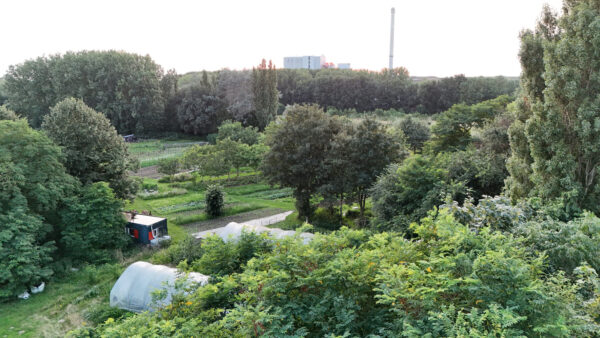
Local food initiatives in Nijmegen are working on regenerative practices, but lack the structural infrastructure to grow and collaborate. In Regeneratieve infrastructuur als hefboom voor een regionale transitie, Tender and Holly Dale are investigating how improved infrastructure can connect and strengthen citizen initiatives in Nijmegen. The research is being carried out in three phases: analysing requirements, making prototypes through co-creation sessions, and translating insights into design frameworks and policy models. This will result in a workbook containing transferable design principles and practical approaches. The core team consists of Holly Dale, Joshua Stevenson, and Kyra van den Hil. Stichting Eetmeerbosch is the main partner. The Municipality of Nijmegen, De Streek op Tafel, and Grondstoffen Collectief Nederland are involved as network partners.
Kathedraallandschappen – Walden Studio
Nature restoration in the Netherlands often fails in the long term: top-down policy is fleeting and bottom-up initiatives remain fragmented. In Kathedraallandschappen (Cathedral Landscapes), Walden Studio and Akademie van Plaats investigate how spatial design can connect local initiatives and contribute to future-proof landscapes. Through design research and fieldwork, designers, ecologists and local stakeholders explore five biotopes in the landscape between the Veluwe, Flevoland and the Utrechtse Heuvelrug. The insights gained are translated into a Kathedraaltoolkit: a visual overview of tangible interventions. Partners involved include ARK Rewilding, Waterschap Vallei en Veluwe, Landschapsbeheer Gelderland, Landschapsbeheer Flevoland, Thuishaven Zeewolde food forest and vegetable garden, and the Zevenbergjes community.
View the full selection in the awarded grants archive (Dutch only).
numbers
This open call uses a two-stage procedure, consisting of a canvas phase and a development phase. In the canvas phase, applicants first submitted a concise project canvas. From the 75 proposals submitted, an advisory committee selected 26 to be developed into full project applications. Each selected team received € 3,000 as financial contribution for this elaboration.
In the subsequent development phase, all 26 detailed applications were presented to the advisory committee. Of these, 20 applications were positively assessed. Within the budget initially available, there was scope to award grants to 14 of these projects. Thanks to an additional € 88,000 released from the follow-up phase of the Open Call Crossing Borders, a fifteenth project could also be supported. This brings the total amount awarded to € 508,356, with a maximum of € 34,000 per project. Budget is also available for a follow-up phase for all 15 selected projects.
follow-up
The selected projects start in April 2026 with the development phase, which runs until the end of October 2026. In this period, the design research will be worked on, as well as new practices, insights and design proposals. The Fund organises peer review and knowledge-sharing sessions during this phase. At the end of the development phase, projects can submit a follow-up application for up to € 44,000 to continue working on the achieved results.


