search

Design-based research is a gift you shouldn’t throw across the room

Suzanne Potjer and Ivo de Jeu have a shared mission: demonstrating that design-based research is an important tool for tackling the spatial challenges we face. Potjer does so from a policy perspective and De Jeu from a design angle. Their motto is: together we can work it out. However, practice proves that patience is the main requirement. How can we ensure that ARO programme plans are adopted more rapidly in practice? A conversation about breathing room, crudness and gifts you don’t really want.

17 August 2026

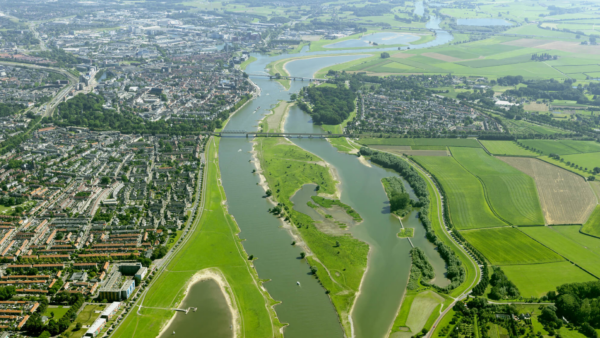
‘There is widespread paralysis in the public domain,’ says public administrator and campaign researcher Suzanne Potjer in the film Ruimte maken (Making Space, premiering on Friday, October 9 at AFFR). ‘We are pretty stuck on a number of levels.’ Hereby referring to the necessary transitions humanity faces which work has only just started on sparingly. However, in the film she stands on the banks of the Waal river, right outside Nijmegen, where the construction of the Veur-Lent island garnered international plaudits years ago. Here, at a critical bottleneck in the Waal, the project Ruimte voor de Rivier (Space for the River) developed into a textbook example of successful design-based research.

Trailer for the film Ruimte maken (Making Space), about how research through design brings together diverse stakeholders to shape complex spatial transitions.

Local design

Rijkswaterstaat (the Ministry of Infrastructure and Water Management) had a solid technical plan for improving water safety there, explains Potjer. However, local groups used a design-based research process to provide a much better idea featuring a side channel and an appealing island – Veur-Lent – in the middle. The designers involved managed to perfectly depict this at a very early stage. People were enthused by the end results outlined, local coalitions developed and initial unrest made way for support. Potjer: ‘This ultimately led to better results than the national government had expected. Not only did it lower water levels as desired, it also had a lot more spatial quality. Basically, we are stupid not to copy such wonderful examples more often.’

Complex process

But why don’t we? ‘The government’s repertoire is still lacking,’ says Potjer. As Chief Exploration Officer for Agenda Stad she aims to renew the governmental repertoire: ‘Design-based research is an auxiliary method that doesn’t come naturally to government yet. Government bodies aim to manage processes and provide certainty. Ironically however, this efficiency means they don’t always achieve their goals.’

They fear that design-based research is more work and makes the development processes even more complex than it already is. While there are so many urgent challenges such as, for instance, the enormous housing shortage. Experimental exploration involving time-consuming participation processes and uncertain results is still often viewed as a superfluous extra that we can’t afford in this day and age.

The complexity of design-based research shouldn’t be feared, but embraced. – Ivo de Jeu

Room to breathe

This enormous pressure for rapid solutions and promised production numbers has a negative effect. ‘The pressure is limiting,’ says Potjer. ‘Design-based research provides room to breathe. A project like Ruimte voor de Rivier reveals that you can also achieve your objectives on time and within budget if you give yourself that room. And it can work out even better than anticipated.’

‘In other words: Just do it!’ responds Ivo de Jeu, Programme Maker Architecture for the Creative Industries Fund NL. ‘The complexity of design-based research shouldn’t be feared, but embraced. Accept that the preliminaries are set to become more complicated and longer, but know that the result phase will be much more fruitful.’

Successful examples

De Jeu uses the Spatial Design Action Programme’s open calls to encourage designers to show off their skills in this field. His mission is to widely publicise as many successful examples of design-based research as possible in the hope that principals will utilise them in practice. Over the past five years, the fund’s calls have provided over 200 of these examples. ‘We want to demonstrate what can be done spatially. In an ideal world, politicians listen to what the population wants, but then the latter does need to know what it can want. This is what design-based research is so good at: exploring and depicting the options.’

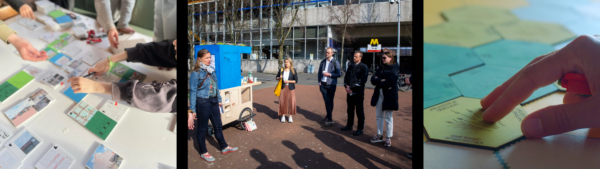
Research through design within ARO projects: co-creative workshops (Studio DMAU), participatory design for mobility hubs (Sprout), and collaborative future development (OD205).

Crude intervention

Create breathing room, so say both Potjer and De Jeu. This is precisely the opposite of the suggestions provided by the STOER advisory committee who recommend lowering ceilings, making stairs steeper and allowing less light into homes so construction can be accelerated. ‘That is just a crude intervention,’ says De Jeu. ‘This is precisely the limited perspective I mentioned before,’ says Potjer. ‘Messing with the regulations so slightly more homes can be built on a plot only leads to neighbourhoods that will soon require fixing.’ Nevertheless, they also feel supported by the attention paid to design-based research in the new Nota Ruimte (spatial planning memorandum): ‘It recognises that humanity faces all manner of transitions, that we need to cooperate intelligently on the limited number of square metres available to us and that design-based research is a good tool for achieving this.’

Don’t over regulate

Potjer warns of an administrative trap: ‘Taking control as a national government does not mean that you should determine everything top down as well as over-regulating everything. People tend to govern on the basis of rules, top down, simplifying things, thinking in abstractions. This isn’t wrong, we need macro-scale frameworks and objectives, but these do demand local variation. The risk of such a national memorandum is that we might start with the big things like nuclear energy for example. And then, energy cooperations will get discussed on the sidelines. Perhaps this should be the other way around? Giving the local room is essential, as this is precisely where answers can be found.’

Giving the local room is essential, as this is precisely where answers can be found. – Suzanne Potjer

Area-oriented open call

The good news is that the Spatial Design Action Programme will be followed-up by a new, seamlessly aligned programme. The open calls will now be area-oriented instead of thematic. De Jeu: ‘This time around we are going for even more local impact’. He expects the transition from plans to practice to become easier as a result. ‘I am looking for proposals from multidisciplinary coalitions that can break out of sectoral stratification. We provide the conditions, we provide room to move, show us your creative plans that attract problem owners into your coalition.’

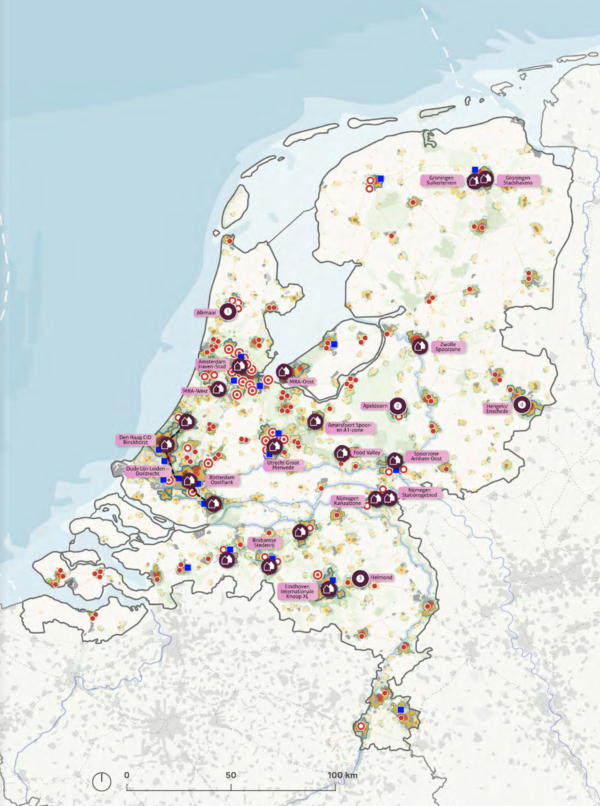
Locations designated by the national government for large-scale housing development in the Spatial Planning Memorandum (Nota Ruimte).

Systemic change

The new open call – that will still be announced this year – confirms that the Nota Ruimte will once again provide financial stimulus to design-based research. But for how long should we continue to subsidise a design and development method that should come naturally in daily practice? ‘You need patience to achieve this kind of systemic change,’ explains De Jeu. ‘Don’t forget that it isn’t always the concrete plans, it is also the way of thinking that slowly percolates through.’

License to expand

And perhaps a subsidy from an independent party is just part of it. The fund is substantively autonomous and makes suggestions for tackling difficult transition challenges from a position somewhere between policy and makers. In the field this creates, the participants are not yet stuck in a typical principal-contractor relationship. ‘This provides a licence to truly expand your field of view, to immerse yourself in the imagination with steps that may not be immediately instrumental,’ says Potjer. ‘If you continue to do this often enough, you will ultimately influence a much broader whole.’

Basket

Potjer has one last word of advice for policy makers who perhaps can’t imagine where to integrate such a process. ‘I would receive a proposal for design-based research like a gift. You have just been given design power for nothing! Remember, gifts are rarely something you would have chosen yourself. I sometimes think of the bicycle basket I was given when I was five. I thought it looked frumpy and threw it across the room, thereby denying myself the chance to find out how useful it was. You have to use something to find out what you can do with it and that definitely also applies to design-based research. So I would suggest: put that basket on your bike and start cycling!’

Text Willemijn de Jonge